idmatch logo
17 Sep 2025

SHOES AND CLEATS: PERFORMANCE STARTS FROM THE BOTTOM

The pedals are one of the three points of contact between the cyclist and the bike; it is therefore necessary to fix the cleats in the correct place to optimise the transmission of foot power.

shoes and cleatsshoes and cleats

When you start cycling 'seriously' - whether on a road bike or MTB - the question of footwear is inevitable.
For optimal pushing without energy loss, it is practically essential to use quick-release pedals and hard-soled shoes with appropriate cleats.
There are many different models, but the aim is always to keep your feet well 'anchored' to the pedals during effort.

The general public first became aware of this technology in 1985, when Bernard Hinault won the Giro d'Italia and the Tour de France with newly designed shoes and pedals.
From that moment on, they became very popular, thanks to the possibility, as we said, of fixing the shoe firmly to the pedal, while at the same time allowing it to be released in a fraction of a second in case of emergency.
The system is very efficient, but you have to consider that, with the foot locked, the muscular force applied during pedalling is transferred more to the knee.
So what can be done to avoid joint problems?


Finding the right position

The pedals are one of the three points of contact between the cyclist and the bike, and since the feet are locked on them, the cleats must be fixed very precisely in the correct place to optimise the transmission of the foot pressure.
Cleat positioning is therefore a very delicate matter; an operation of the utmost importance, not only for pedalling efficiency and comfort, but also to harmonise the entire biomechanical set-up.
In this process, the main factor to be taken into consideration is the one concerning the foot-shoe + pedal assembly; this means that in order to achieve the best combination it is fundamental to find the exact correspondence with the pedal axis.

Keep in mind that a wrong alignment between foot and pedal produces an incorrect movement and could determine a risk of functional overload to tendons and joints of the whole lower limb.


shoes and cleats blog


Cleats à l'endroit exact en 60 secondes

Optimum cleat positioning cannot be established on the basis of general guidelines, but only by means of personalised adjustments to be carried out by experienced technicians with the help of a scientifically reliable instrument such as idmatch Cleat Fit.
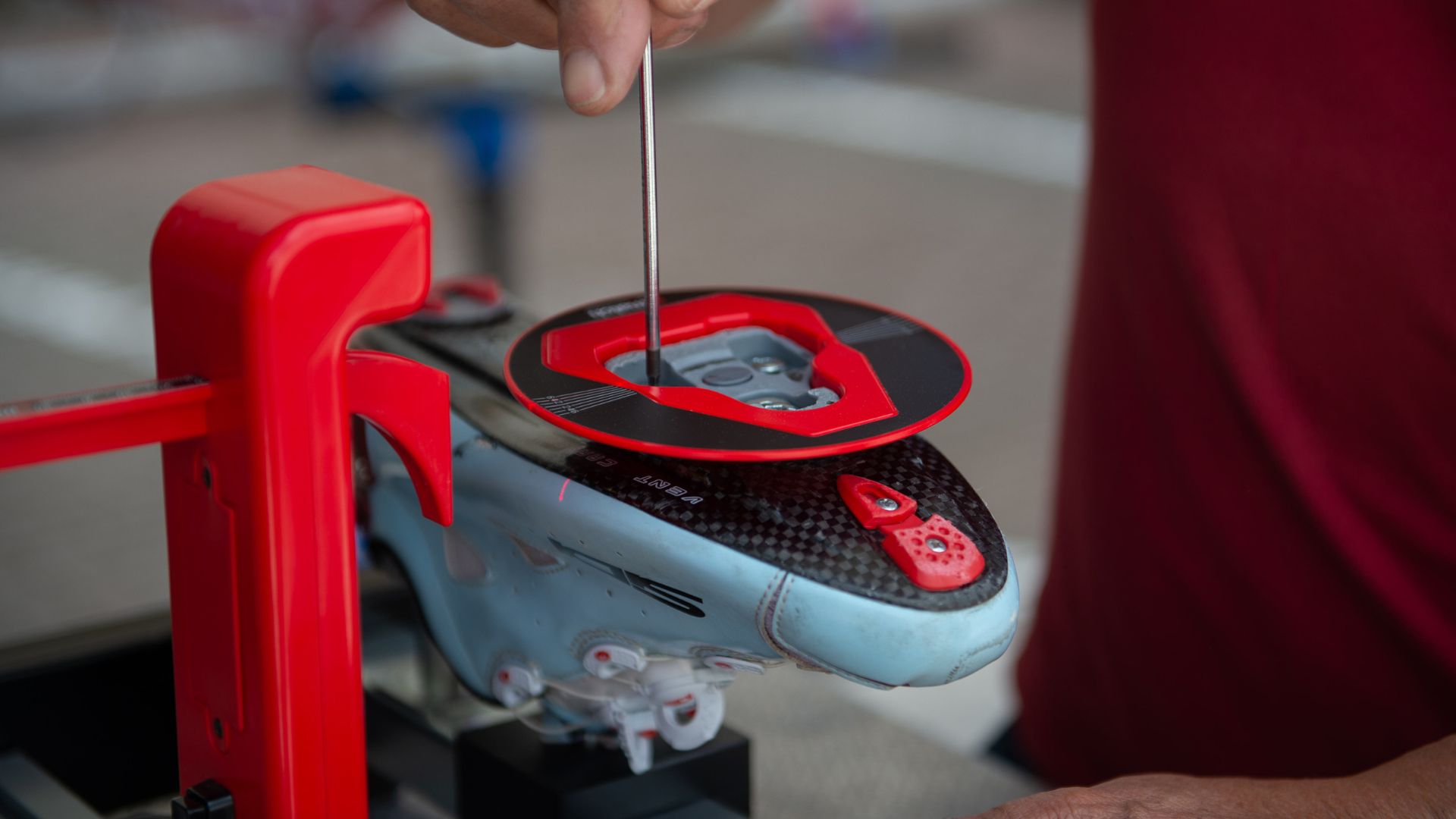
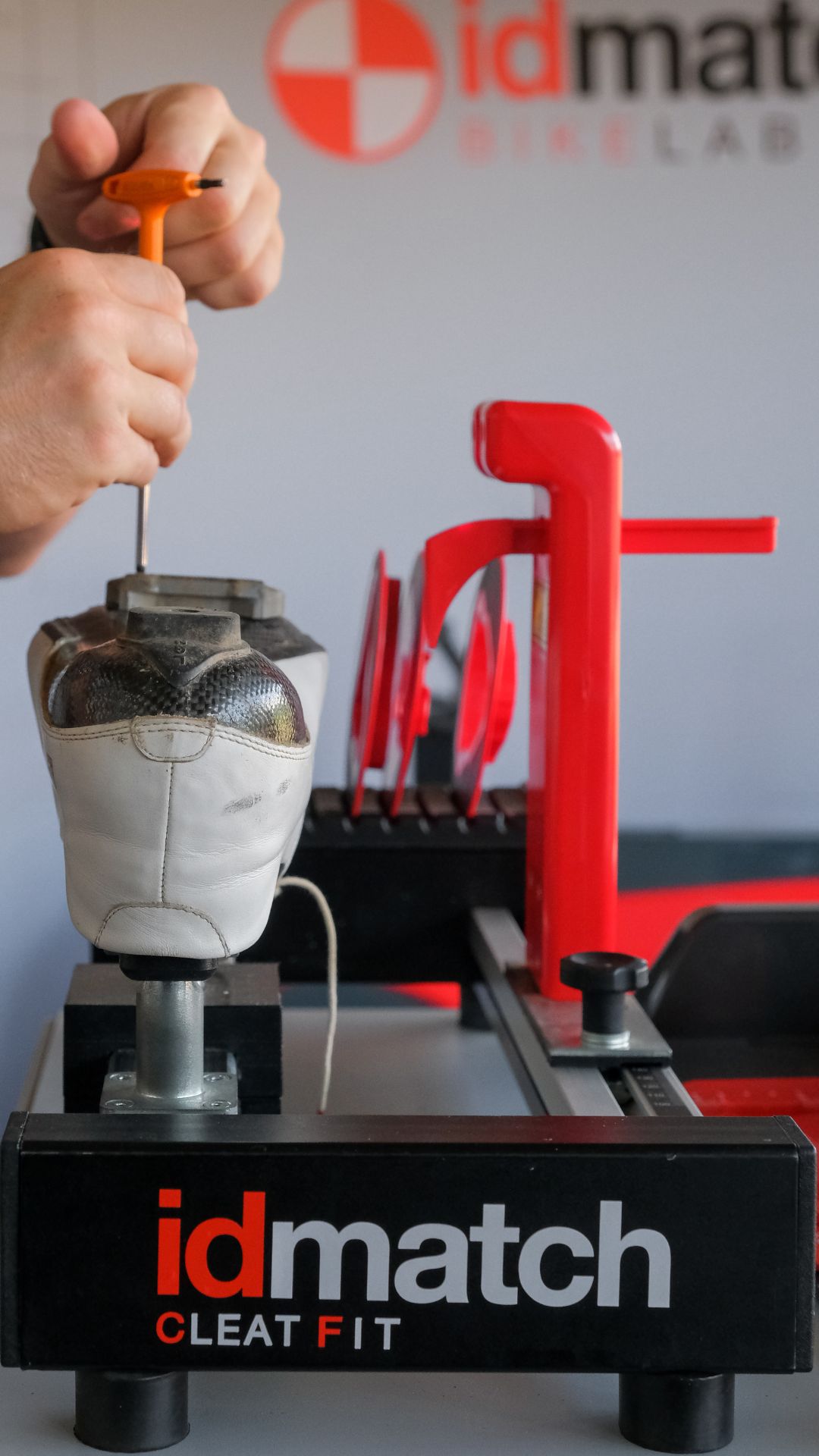
idmatch Cleat Fit is a simple and practical, but technologically innovative measuring system that, carried out from inside the shoe, allows the measurements taken on the foot to be transferred directly to the sole in just a few seconds, achieving maximum precision in the final positioning of the cleat.
In practical terms, it is possible to use a laser beam to exactly record the position of the pedal axis under the shoe. A goniometer disc applied to the cleat then makes it possible to check both its distance from the heel and its rotation with respect to the longitudinal axis of the shoe.
A unique innovation in the world, capable of allowing the cyclist to find the best possible position on the pedals in less than a minute, thus optimising performance and preventing any musculoskeletal problems.

All the information relating to the characteristics of the foot can also be entered in the free webapp in the idmatch customer area (my.idmatch.it), obtaining the coordinates for the correct positioning of the cleat.

You may also be interested in:

How to choose the optimal saddle
There is no doubt that one of the most important points for comfort on a bike is the support on the saddle. Amateurs, amateurs and professionals are constantly looking for a comfortable and functional support, which guarantees their comfort but also an adequate performance. Furthermore, inadequate support on the saddle can accentuate problems already present […]
How to choose crank length?
The inability to perceive in the short term the advantages or disadvantages of a longer or shorter crank length leads to the mistaken belief that the choice of this component can be cursory. If you look at the numbers that result from different choices you can immediately understand how important an adequate crank length is. […]
Riding position on a gravel bike
If we analyse a gravel bike in detail we find that it adopts a greater drop between the wheel hub and the bottom bracket to increase stability. It uses a slightly more relaxed steering column angle to distribute less load on the front end, preventing understeer in tight turns on "gravel" and, consequently, a slightly […]
1 2 3
Vantaggi bikefitter

Discover the benefits of being an idmatch bikefitter

Discover

Contact the idmatch sales team

Contact Us
Via E.Fermi 2, Casella D’Asolo (TV), 31011, Italia
Newsletter
Receive news and updates
Email form EN
chevron-down